Enterprise AI Security
Building Secure RAG Pipelines for Sensitive Enterprise Knowledge
Generative AI holds massive value for enterprise knowledge management, but data leakage is a serious risk. Learn how to isolate vector embeddings by organizational security clearance and build safer Retrieval-Augmented Generation pipelines.
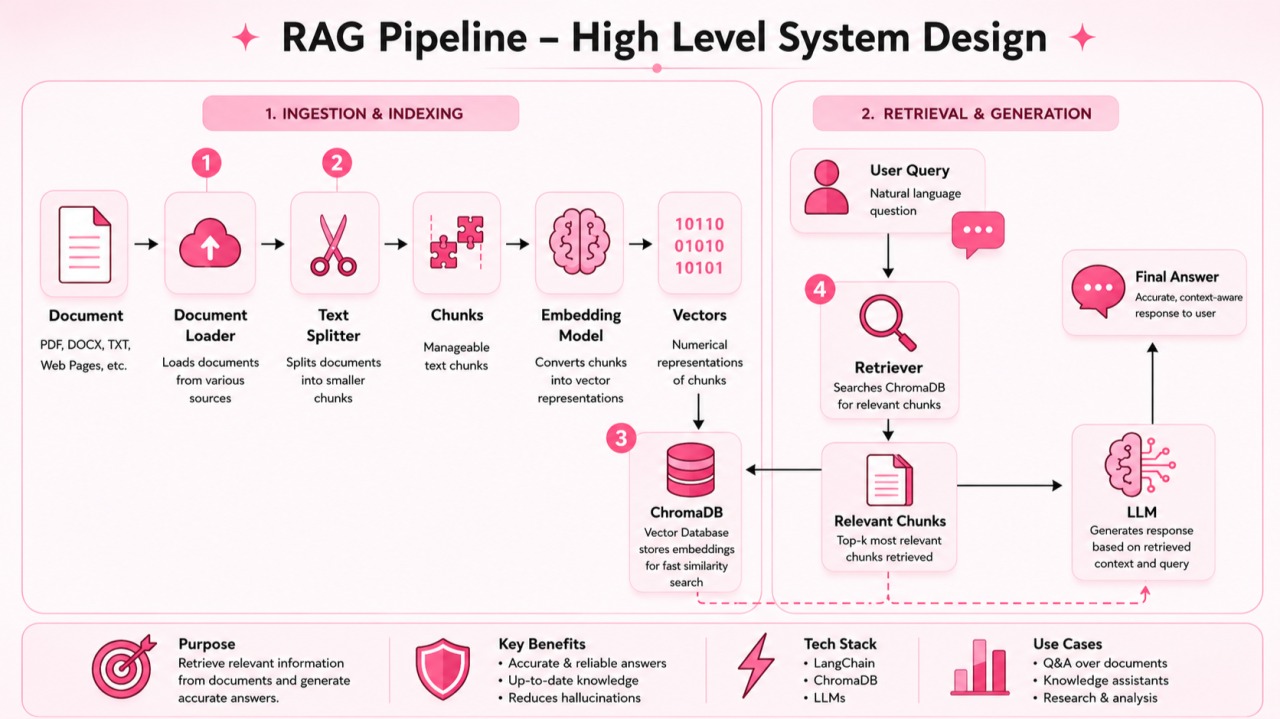
Retrieval-Augmented Generation (RAG) helps businesses use artificial intelligence with their internal documents and organizational knowledge. However, when this information includes confidential or sensitive data, strong security and access control are essential.
A secure RAG system must ensure that users can retrieve only the information they are authorized to access. Permissions should apply not only to the original documents, but also to the chunks, metadata, and vector embeddings stored in the knowledge base.
1. Protect Sensitive Information
Business documents should be stored securely and protected with appropriate authentication, encryption, and access policies. Before documents are processed, organizations should classify sensitive content such as financial records, customer information, legal documents, and internal strategy files.
Sensitive information should never be available to users who do not have the required permissions. Data protection should begin during document ingestion and continue through embedding, storage, retrieval, and response generation.
2. Apply Role-Based Access
Use roles, departments, teams, organizational units, or individual permissions to control which documents and information can be retrieved. For example, a finance employee may access financial reports, while an engineering employee may access technical documentation.
Each document chunk should include security metadata such as classification level, tenant, department, owner, permitted roles, and permitted users. These permissions should be checked during retrieval, before the content is sent to the AI model.
Filtering results after retrieval is not enough. Unauthorized content should never enter the model context because even a rejected result may create an opportunity for information leakage.
3. Isolate Vector Embeddings
Vector embeddings should be treated as sensitive business data. Although embeddings are numerical representations of documents, they can still reveal information about the original content when improperly accessed or analyzed.
Organizations should isolate embeddings according to their security requirements. This may include separate collections, namespaces, indexes, or databases for different tenants, departments, or clearance levels.
In a shared vector database, every chunk should include filterable access control metadata. The retrieval query must apply tenant, role, and clearance filters before similarity search results are returned.
Technologies such as pgvector can support efficient vector search, but database-level authentication, encryption, network protection, and authorization policies are still required.
4. Monitor AI and Data Access
Security teams should monitor important activities across the RAG pipeline. This includes document uploads, embedding generation, searches, retrieved documents, user identities, model requests, and administrative actions.
Audit logs can help organizations detect unusual behavior, investigate security incidents, and demonstrate compliance. Alerts can also be configured for activities such as repeated access-denied events, unusually large retrieval requests, or searches involving highly restricted information.
5. Secure the Knowledge Base
A secure knowledge base must protect both original documents and their vector representations. Use encryption for data at rest and in transit, separate read and write credentials, and restrict write access to trusted ingestion services.
Organizations should also scan documents before they are chunked and embedded. This process may include sensitive-data detection, personally identifiable information filtering, malware scanning, and prompt-injection detection.
When source-system permissions change, those changes should be synchronized with the vector database. Stale permissions can allow users to retrieve documents they are no longer authorized to access.
Conclusion
A secure RAG system must balance AI usefulness with strong data protection. Access control should be enforced throughout the complete pipeline, from document ingestion to vector storage, retrieval, model context, and final response.
By combining secure storage, role-based access, clearance-aware vector isolation, permission-aware retrieval, and continuous monitoring, businesses can use internal knowledge with greater confidence.
Make AI useful. Protect sensitive data. Control access.