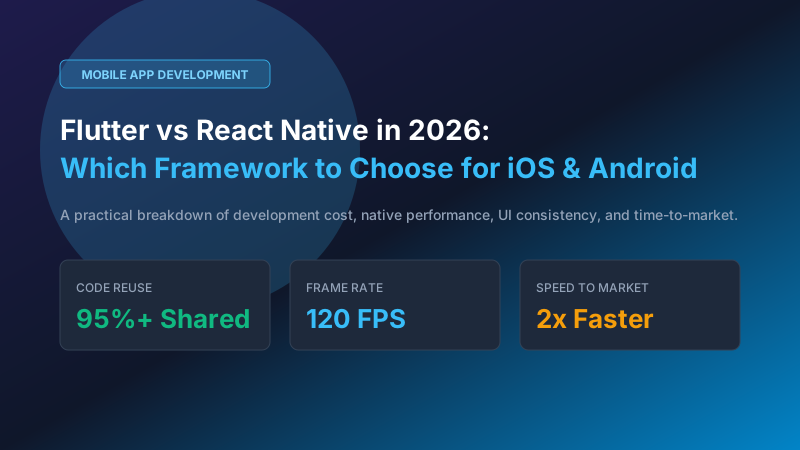
When launching a new mobile app, choosing between Flutter and React Native is one of the most impactful decisions you will make. Both frameworks allow you to ship iOS and Android apps from a single codebase, saving up to 40% in engineering costs.
Performance & Rendering Engine
Flutter compiles directly to native ARM machine code using the Impeller rendering engine, ensuring consistent 120 FPS animations and fluid custom UI components across both operating systems. React Native relies on the Hermes Javascript engine and the Fabric architecture to render native OEM components.
Ecosystem & Developer Availability
React Native benefits from the vast JavaScript and React ecosystem. If your team already has React web developers, onboarding to React Native is remarkably fast. Flutter uses Google's Dart language, which is intuitive for developers coming from C#, Java, or TypeScript.
Our Recommendation
- Choose Flutter: If your application features custom graphic-rich UI, real-time map tracking (such as car rental or ride-sharing), or needs pixel-perfect consistency across devices.
- Choose React Native: If your app heavily integrates with an existing React web ecosystem or requires frequent OTA (over-the-air) code updates.